Astronomers Reveal a Co-Precessing Black Hole Disk-Jet System
A tidal disruption event (TDE) occurs when a star approaches a supermassive black hole at the center of a galaxy and is torn apart by tidal forces. Some of the stellar material falls back to form a hot accretion disk, releasing intense radiation. An international research team has reported the strongest evidence so far for disk-jet co-precession in the TDE AT2020afhd, a long-predicted consequence of spacetime dragging around a spinning black hole.
AT2020afhd lies at the center of the galaxy LEDA 145386, approximately 400 million light-years from Earth. It was identified in January 2024 through an optical sky. Shortly afterward, the team initiated an international coordinated observing campaign, using the space-based X-ray telescopes, as well as the radio interferometric arrays, supplemented by optical observations from China’s Xinglong 2.16-m and Lijiang 2.4-m telescopes. This effort enabled more than a year of high-cadence, multi-wavelength monitoring.
A systematic analysis revealed that roughly 215 days after its optical discovery, the X-ray emission exhibited striking quasi-periodic oscillations with a period of 19.6 days and an amplitude exceeding an order of magnitude. The radio emission also showed strong variations with amplitudes over a factor of four, closely synchronized with the X-rays. “Such cross-band, high-amplitude, quasi-periodic synchronous variability strongly indicates a rigid coupling between the accretion disk and the jet, precessing like a gyroscope around the black hole’s spin axis,” said Wang Yanan, the paper’s first author and a researcher at National Astronomical Observatories of the Chinese Academy of Sciences (NAOC).
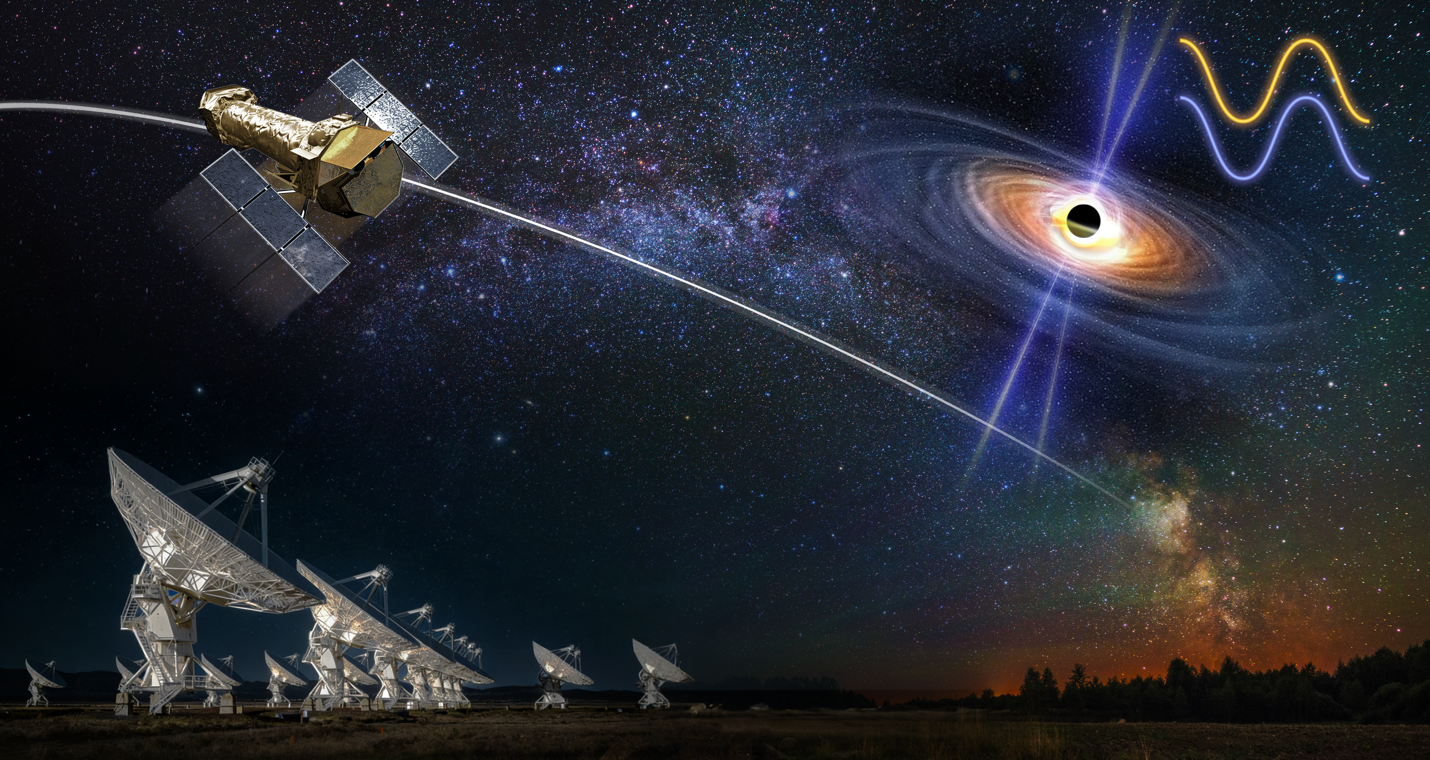
Artist’s impression of disk-jet co-precession in a black hole system (Credit: Xu Zhang). Space-based X-ray telescopes detect high-energy radiation from the innermost regions of the accretion disk, while ground-based radio arrays capture the radio signals emitted by the jet.
The physical mechanism behind disk-jet co-precession likely arises from the Lense-Thirring effect, in which a spinning black hole drags the surrounding spacetime, causing a tilted accretion disk and the jet perpendicular to it to co-precess. Although long predicted by theory and simulations, obtaining clear observational confirmation has been extremely challenging. “This is the first time that disk-jet co-precession has been clearly observed in a black hole system, which is truly exciting,” said co-corresponding author Huang Yang, Associate Professor at the University of Chinese Academy of Sciences. Co-corresponding author Lei Weihua, Professor at Huazhong University of Science and Technology, added: “After noticing its unusually strong variability early in the outburst, we maintained intensive multi-band monitoring for more than a year, ultimately uncovering and successfully explaining the physical origin of this unique phenomenon. Previous observations of TDEs have often focused only on their early stages; long-term monitoring has been rare and technically challenging.”
The team constructed a disk-jet co-precession model that successfully reproduced both the X-ray and radio variability, yielding clear constraints on the system geometry, black hole spin, and jet speed. “This phenomenon may be common, but has likely been missed due to limitations in past observing strategies,” said co-corresponding author Liu Jifeng, a researcher at NAOC. “With the upcoming all-sky, deep, multi-band, high-cadence surveys from the SiTian project and the Einstein Probe, we expect to discover many more such events, advancing our understanding of black hole accretion physics.”
The paper is available at: https://www.science.org/doi/10.1126/sciadv.ady9068