International DESI Project Successfully Completes Five-Year Survey Plan
BEIJING, April16, 2026, the Dark Energy Spectroscopic Instrument (DESI) project, a global collaboration involving over 70 research institutions and more than 900 scientists worldwide, including the National Astronomical Observatories of Chinese Academy of Sciences (NAOC), announced the successful completion of its planned five-year spectroscopic survey. The project has constructed the largest and highest-resolution three-dimensional map of the universe to date, far exceeding its initial observation targets. It has successfully obtained spectral data for over 47 million galaxies and quasars, surpassing the original goal of 34 million, and has additionally recorded data for 20 million stars within the Milky Way. This achievement lays an unprecedented data foundation for exploring the mysteries of the universe, such as dark energy.
The DESI project aims to map the three-dimensional structure of the universe by capturing the spectra of tens of millions of distant celestial objects, precisely tracing 11 billion years of cosmic evolution, and measuring dark energy, which is the mysterious force driving the accelerated expansion of the universe. Preliminary analyses based on the project's first three years of data hinted that dark energy might not be constant but could evolve with cosmic time. If confirmed by the final analysis of all five years of data, this discovery could revolutionize our understanding of the universe's composition and its ultimate fate.
In this global collaboration, NAOC has been a significant participant, making substantive contributions in scientific analysis and survey operations. In terms of observational support, NAOC researchers have contributed over 90 observer-nights of telescope time, supporting efficient data acquisition. In cutting-edge scientific research, the team led by Professor Zhao Gongbo has been deeply involved in the DESI international collaboration's work on dynamical dark energy. Utilizing DESI data, the team conducted independent tests on the nature of dark energy, providing crucial analysis for exploring whether dark energy evolves over time. Meanwhile, the team led by Professor Zou Hu has utilized DESI spectroscopic data to detect a large sample of extremely metal-poor galaxies, probing the cool gas medium around galaxies and the dense environments of galaxy clusters, which offers important clues for revealing early galactic evolution and environmental influences. In addition, the team’s discovery and study of a large sample of “changing-look” active galactic nuclei have opened a new pathway for understanding the mechanisms behind the dramatic transitions in the activity of supermassive black holes at the centers of galaxies.
According to the project plan, DESI's exploration is far from over. Observations will continue until 2028, with the survey's sky coverage expanding from approximately 14,000 square degrees to about 17,000 square degrees. The extended survey will observe more challenging regions of the sky and re-scan certain areas to obtain information on fainter galaxies, thereby creating a denser and more detailed map of the universe's structure. This will further enhance the precision of dark energy measurements and support related research into dark matter.
The success of the DESI project stands as a model of international large-scale scientific collaboration. The vast amount of data it has produced will continue to drive forefront research in cosmology. In-depth analysis of the complete five-year dataset is now underway, with the first comprehensive results on dark energy expected to be released in 2027, potentially bringing new breakthroughs to our understanding of the cosmos.
DESI is supported by the DOE Office of Science and by the National Energy Research Scientific Computing Center, a DOE Office of Science national user facility. Additional support for DESI is provided by the U.S. National Science Foundation; the Science and Technology Facilities Council of the United Kingdom; the Gordon and Betty Moore Foundation; the Heising-Simons Foundation; the French Alternative Energies and Atomic Energy Commission (CEA); the Secretariat of Science, Humanities, Technology and Innovation (SECIHTI) of Mexico; the Ministry of Science and Innovation of Spain; and by the DESI member institutions.
The DESI collaboration is honored to be permitted to conduct scientific research on I’oligam Du’ag (Kitt Peak), a mountain with particular significance to the Tohono O’odham Nation.
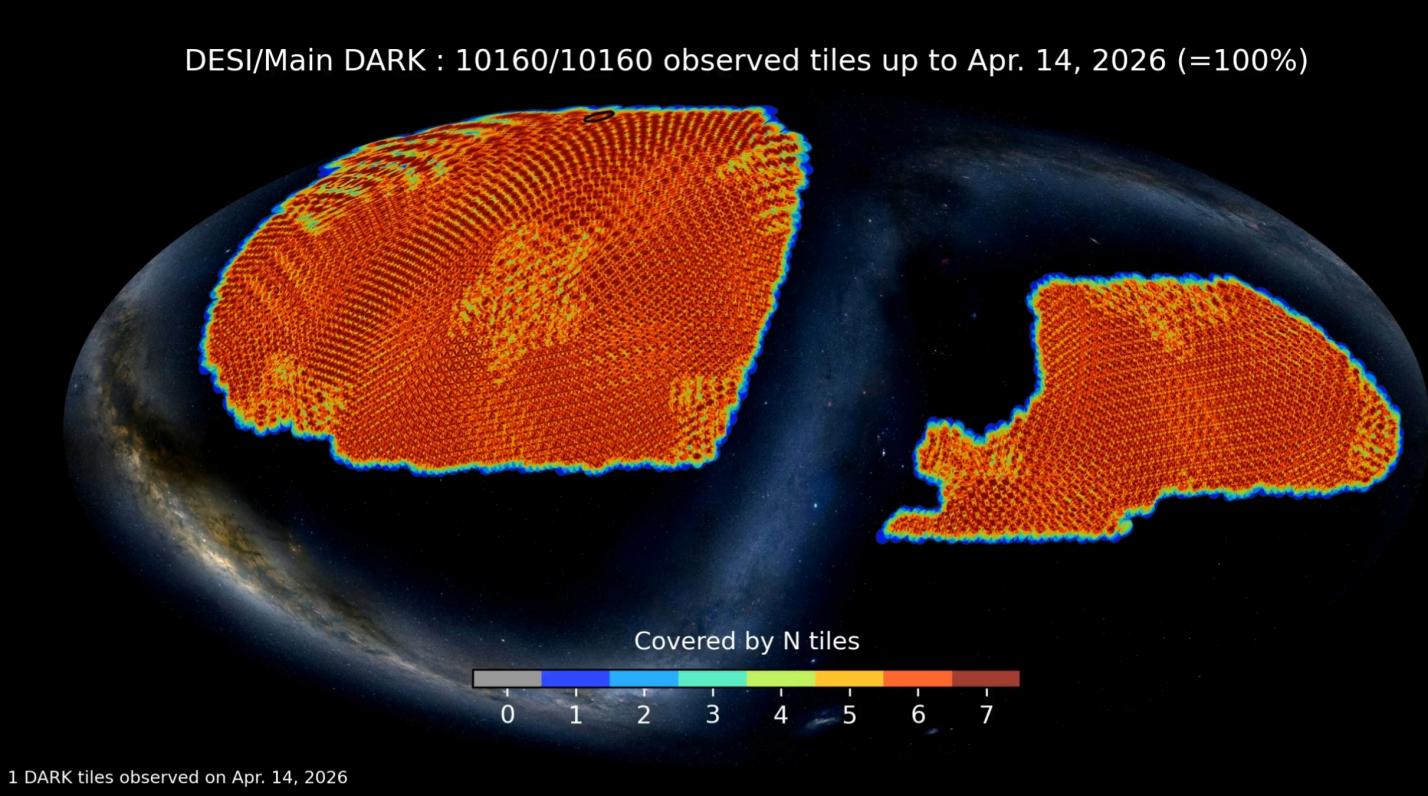
Figure 1. The DESI survey coverage area, approximately 14,000 square degrees, with each region observed multiple times to achieve the target galaxy density. Credit: DESI collaboration.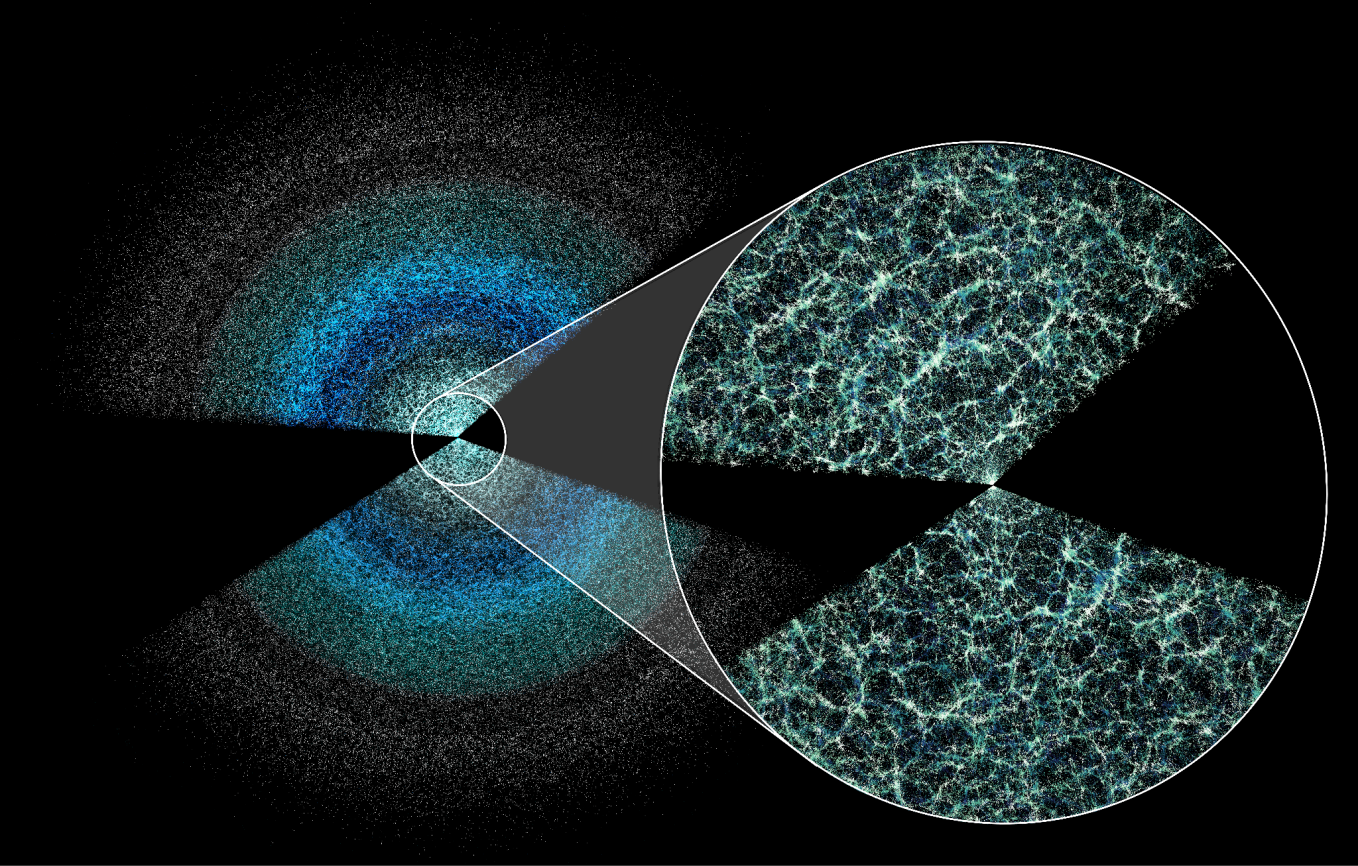
Figure 2. A slice of the universe 3D map from the DESI five-year survey, showing the spatial distribution of galaxies and quasars above and below the plane of the Milky Way. The magnified inset reveals the large-scale structure of the universe. Light from the farthest galaxies shown has traveled for 11 billion years to reach Earth. Credit: DESI collaboration.