Sagittarius Stream Reveals the Hidden Structure of a Disrupted Dwarf Galaxy
The Milky Way is filled with the remains of galaxies it has torn apart. But what were those galaxies like before their destruction? The dwarf galaxies that survive today may not represent those that have been lost. Without reconstructing these disrupted galaxies, our picture of dwarf galaxy evolution—and the Milky Way's own history—remains incomplete.
A research team led by CAS Academician ZHAO Gang at the National Astronomical Observatories of the Chinese Academy of Sciences (NAOC), working with colleagues at Purple Mountain Observatory (PMO) and other institutions, has taken a step toward filling that gap. By combining the chemistry and motions of stars in the Sagittarius stream with N-body simulations, the researchers found evidence that its progenitor, the Sagittarius dwarf galaxy, once hosted a rotating stellar disk. The disk had an unusual ∧-like metallicity profile, in which the average stellar metallicity first increased and then decreased with radius. The finding was published in Nature Astronomy on October 13, 2026.
Recovering a disrupted galaxy's original structure is difficult. Even progenitors with very different internal structures can leave streams with similar present-day stellar positions and velocities. That is why astronomers have long debated whether Sagittarius originally contained a rotating disk—and why chemical information can provide an important additional test.
“In our simulations, a rotating disk alone was not enough,” said GUO Zixi of NAOC, a co-first author of the paper. “Its radial metallicity distribution was crucial to reproducing the observations in both stream arms.”
“A stellar stream is not just the debris of a disrupted galaxy. It also preserves clues to what that galaxy was like before it was torn apart,” said Prof. XUE Xiangxiang of NAOC, a co-first and co-corresponding author of the paper. “By combining the chemical compositions and motions of its stars with N-body simulations, we can use those clues to investigate the progenitor’s original structure.”
The team combined metallicities, radial velocities and distances from the Large Sky Area Multi-Object Fiber Spectroscopic Telescope (LAMOST) and the Sloan Digital Sky Survey (SDSS) with proper motions measured by Gaia. In astronomy, elements heavier than helium are called “metals”; metallicity describes their abundance. For the Sagittarius stream, the researchers used iron abundance relative to hydrogen ([Fe/H]) as an indicator of stellar metallicity.
They examined the stream's leading and trailing arms, which extend ahead of and behind the dwarf galaxy's surviving core along its orbit. In both arms, stars nearer the Milky Way's center tend to be more metal-rich than those farther out. This creates a gradient across the stream, roughly perpendicular to its direction of motion.
The team identified a corresponding relationship between metallicity and angular momentum, which combines a star's position and velocity. The correlation persisted across different stellar samples and well-sampled regions of the stream.
“The correlation between metallicity and angular momentum suggested that rotation in the progenitor might have left a chemical imprint in the stream,” said Prof. LIU Chao of NAOC, a co-corresponding author of the paper. “That was the clue we wanted to test with different progenitor structures.”
To test this interpretation, the researchers conducted N-body simulations to trace how stars were stripped from progenitor galaxies with different structures and how they formed stellar streams. They compared three types of progenitor models—disk galaxies, spheroidal galaxies and rotating elliptical galaxies—each with one of two radial metallicity profiles: one that decreased continuously outward and another that first increased and then decreased with radius.
Of the models tested, only a rotating disk with the rise-and-fall metallicity profile reproduced the observed metallicity–angular-momentum correlations in both arms.
“The two arms of the Sagittarius stream provide different pieces of information about the original galaxy,” said Prof. CHANG Jiang of PMO. “Our simulations show that the leading arm mainly traces stars from farther out in the progenitor, while the trailing arm provides information about regions closer to its center. Together, they help us constrain the galaxy’s unusual metallicity profile.”
To investigate whether the unusual ∧-like metallicity profile inferred for the Sagittarius dwarf galaxy also exists in surviving dwarf galaxies, the team used data from the SDSS Mapping Nearby Galaxies at Apache Point Observatory (MaNGA) survey to examine how stellar metallicity varies with distance from the centers of other dwarf galaxies. They identified three clear examples of similar profiles among a selected sample of 217 dwarf galaxies. The pattern is uncommon in that sample, but not unique to the Sagittarius dwarf galaxy.
A similar radial metallicity profile has also been reported for the Milky Way. Whether these resemblances reflect shared physical processes remains an open question. By recovering properties of disrupted dwarfs, the study helps bring galaxies missing from today's surviving population into comparisons of dwarf galaxy evolution.
“The Sagittarius stream gives us an opportunity to recover part of the original galaxy’s structure and compare it with present-day dwarf galaxies,” said Prof. ZHAO Gang of NAOC, a co-corresponding author of the paper. “Such comparisons can help us better understand how dwarf galaxies formed and evolved.”
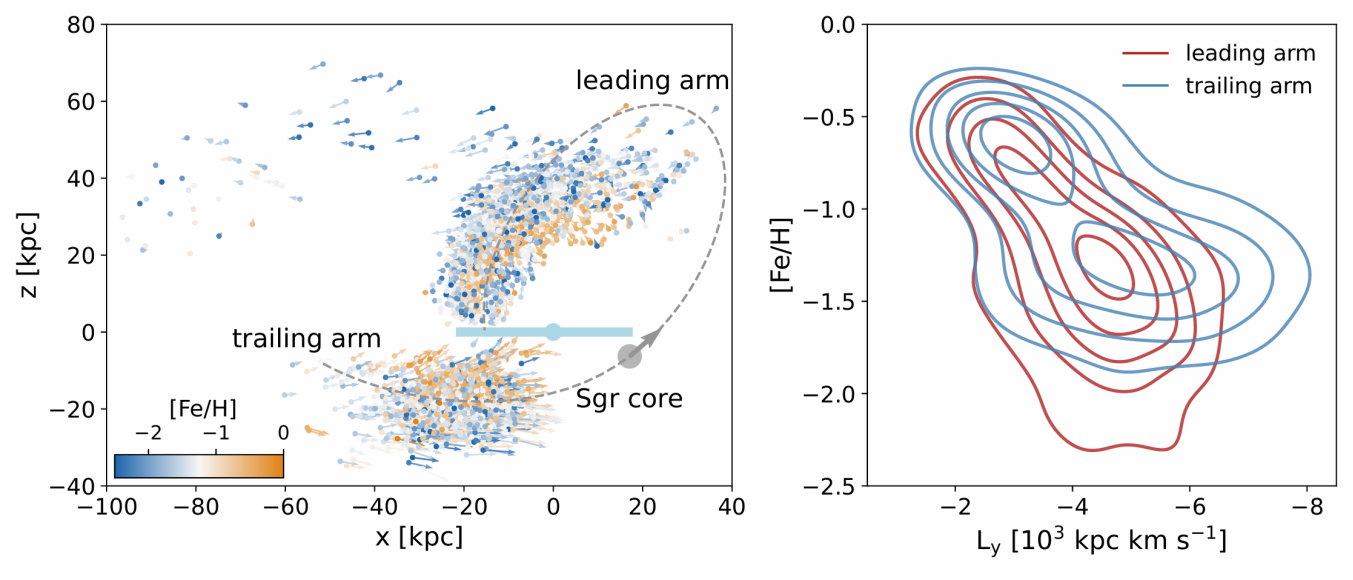
Distribution of the Sgr stream members. Left panel: The spatial distribution of the Sgr leading arm and trailing arm in the Galactocentric coordinate system. The Milky Way disk plane is shown by a blue line, and its center by a blue dot. The grey dot represents the position of the Sgr core, the grey dashed line traces its orbital trajectory, and the grey arrow indicates the direction of its movement. Arrows represent the Sgr stars’ moving directions and velocity amplitudes, and every star is color-coded according to its metallicity. Right panel: [Fe/H] - Ly correlation. The red contour and the blue contour represent the distribution of the leading arm and the trailing arm, respectively. Ly and [Fe/H] are correlated in both the leading arm and the trailing arm. (Image by the research team)
Paper link: https://www.nature.com/articles/s41550-026-02996-2