FAST Identifies the Principal Driver of Star Formation Feedback in Orion's Veil Bubble
A research team led by scientists from the Chinese Academy of Sciences (CAS) has utilized the Five-hundred-meter Aperture Spherical radio Telescope (FAST) to conduct the first direct comparison of the kinetic energy feedback provided by stellar winds versus radiation within the same interstellar bubble.
The study, published online in *Science Advances* on September 4, 2026, reveals that while both mechanisms play a role in shaping the "Veil bubble" in Orion, wind-driven gas expands faster and carries approximately twice the kinetic energy of gas driven by radiation.
Massive stars reshape their birth clouds long before they end their lives as supernovae. They emit intense ultraviolet radiation that heats and ionizes nearby gas, while simultaneously ejecting streams of high-speed particles known as stellar winds. Together, these feedback mechanisms produce cavities, compress surrounding material, and regulate the formation of the next generation of stars and planets. The simultaneous operation and spatial overlap of the two mechanisms make it observationally challenging to disentangle the relative dynamical contributions of radiation and stellar winds.
The Veil bubble in the Orion A molecular cloud provides a rare opportunity to distinguish their respective effects within a single system. Located in the nearest massive star-forming region to the Solar System and powered by the massive stars of the Trapezium cluster, the bubble shows a pronounced spatial asymmetry: photoionized gas dominates the northeastern side, whereas hot plasma associated with stellar winds occupies the southwestern side. This configuration makes the Veil bubble a natural laboratory for comparing the dynamical effects of the two feedback processes under closely matched physical conditions.
Using neutral hydrogen (H I) observations from the Commensal Radio Astronomy FAST Survey (CRAFTS), the researchers identified a coherent, heart-shaped H I shell surrounding the previously known ionized bubble. By tracing the shell's velocity structure and estimating the mass of the expanding gas, the team derived its expansion kinetic energy across the bubble. After accounting for the bubble's geometry, they found that the wind-dominated region carries approximately twice the kinetic energy of the radiation-dominated region, providing a direct comparison of the dynamical contributions of the two feedback processes.
These results argue against a simple picture in which a single feedback mechanism controls the dynamics of the entire bubble. Instead, both radiation and stellar winds contribute to its expansion, while the wind-dominated region exhibits higher expansion velocities and greater kinetic energy.
By enabling a direct comparison of the two feedback processes within the same interstellar bubble, the study provides new observational constraints on models of massive-star feedback. Such constraints are important for understanding how massive stars regulate subsequent star formation and reshape the surrounding interstellar medium. Extending this analysis to larger, multiwavelength samples will be necessary to determine whether the relative contributions of radiation and stellar winds change with evolutionary stage or on galactic scales.
The research was contributed equally by LI Chong (Purple Mountain Observatory, CAS) and LI Rouyu (National Astronomical Observatories, CAS), with QIU Keping (Nanjing University) and LI Di (Tsinghua University) as the corresponding authors. The work was supported by the National Natural Science Foundation of China and the National Key Research and Development Program of China.
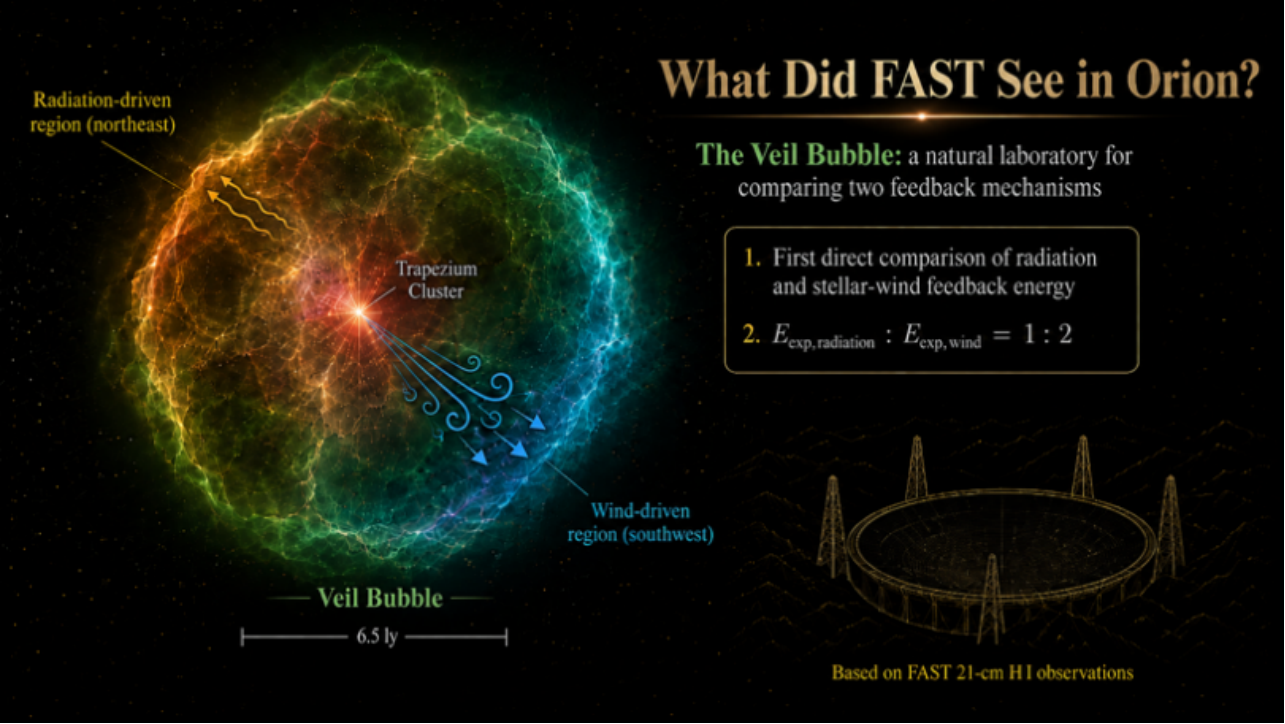
Promotional graphic showing the radiation-driven and wind-driven regions of the Veil bubble and the stronger kinetic-energy input on the wind-dominated side. (Image by the research team)
Paper link: https://doi.org/10.1126/sciadv.aec0787